📊 Premium DCA Tool

Dollar Cost Averaging Calculator

Understand how regular investing can lower average purchase price, reduce market timing stress, and build units over time. This calculator compares DCA with lump sum investing and shows how your portfolio value evolves across each investing period.

Track every regular purchase clearly Enter a fixed investing amount, choose weekly, monthly, or quarterly frequency, and see how many units you buy in each period.
Compare DCA with lump sum behavior Measure whether spreading purchases helped or hurt versus investing the full planned amount at the starting price.
Use manual prices or a simulation path Build a custom period-by-period price table or let the calculator simulate growth from an initial asset price.
Dollar Cost Averaging Dashboard

Display Currency

Display only. This calculator does not apply exchange-rate conversion.

What this tool answers

How much did you invest, how many units did you accumulate, and what average price did you pay?
How does regular investing compare with putting the full planned capital in at the start?
How does your current market price change portfolio value, profit or loss, and long-term investing discipline?

Start with the amount you invest each period, the investing frequency, the number of contributions, and the current market price used for today's portfolio valuation.

This is the fixed amount invested every week, month, or quarter.
$500.00
Frequency changes the meaning of each period and the simulation price path.
Example: 24 monthly periods means 24 separate monthly investments.
24 periods
This price is used to value all accumulated units today.
$130.00

DCA reminder

With DCA, the same money buys more units at low prices and fewer units at high prices.
That can lower your average purchase price, but it does not guarantee a profit.

Use Manual Price Mode when you want to enter the asset price for each investing period yourself. This is useful for backtesting a real price path, mutual fund NAV history, stock closing prices, or a custom scenario.

Manual Price Entry Table

Period Asset Price ($)

Enter one positive price for every selected period. The calculator will automatically compute units purchased from the fixed investing amount each time.

Tip: Manual mode is great for showing how buying more units during dips can lower your average cost over time 📈

Use Simulation Mode when you want the asset price to grow or decline automatically from a starting price. This is useful for testing simple scenarios without manually entering each price.

The starting price used to generate the simulated price path.
$100.00
This annual growth rate can be positive or negative. It is applied across the selected frequency.
8.00%

How simulation works

Each period price is generated as Initial Price x (1 + growth / periods per year)^period.
The current asset price from setup still values your final holdings, so you can compare the simulated purchase path with today's market price.
Latest Result: DCA Analysis
Nothing copied yet.
Total Investment
-
Fixed amount invested across all periods
Total Units Purchased
-
All units accumulated from each contribution
Average Purchase Price
-
Average cost paid per unit across the full plan
Portfolio Value
-
Current asset price multiplied by total units held
Total Profit or Loss
-
Difference between current portfolio value and total investment
Percentage Return
-
Profit or loss relative to total money invested
DCA Snapshot
Quick highlights behind your latest dollar cost averaging analysis.
Metric Value Explanation
Visual DCA Dashboard

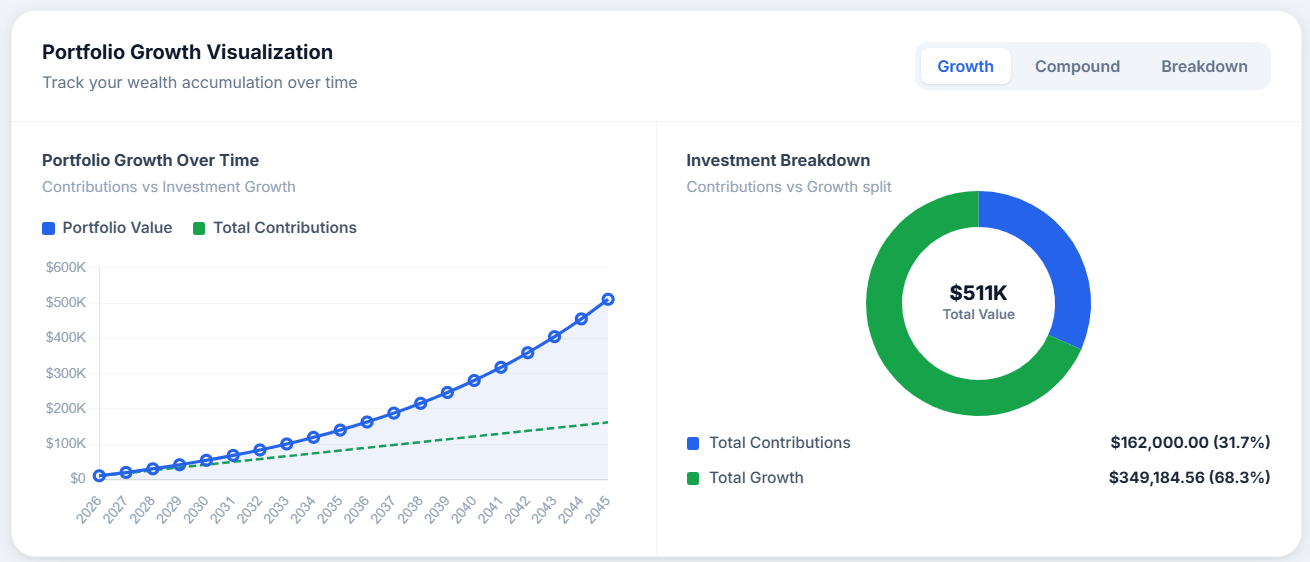
Charts compare invested capital, portfolio value, units accumulation, and DCA versus lump sum behavior.

Total Invested vs Portfolio Value
See how cumulative investment compares with the portfolio value at each period price.
Units Purchased and Total Units
Track how many units each contribution buys and how total units build over time.
DCA vs Lump Sum Comparison
Compare the DCA portfolio path with investing the full planned capital at the starting price.
Detailed Investment Table
Period-by-period table showing asset price, fixed investment amount, units purchased, total units held, and portfolio value using each period's price.

Comparison Tables

These quick references show how DCA differs from other common investing approaches and why many investors use it for discipline, consistency, and emotional comfort.

DCA vs Lump Sum vs SIP

Factor DCA Lump Sum SIP
How money is investedFixed amount over regular periodsAll capital invested at onceFixed amount on a recurring schedule
Main goalReduce timing risk and average costPut money to work immediatelyAutomate disciplined long-term investing
Works well whenMarkets are volatile or investor is cautiousInvestor has capital ready and long horizonSalary-based saving happens every month
Emotional benefitOften lowers regret from one bad entry pointCan be stressful if market drops soon after investingCreates routine and habit
Potential drawbackMay trail lump sum in strong rising marketsHigher entry timing riskMay be less flexible if income changes

Benefits and Limitations of DCA

Average Purchase Price = Total Investment / Total Units
Aspect Benefit Limitation
TimingSpreads risk across multiple entry pointsDoes not guarantee a better final return
BehaviorEncourages discipline and routineInvestors may stop when markets feel scary
VolatilityCan buy more units when price fallsStill exposed to market losses
Cash deploymentUseful when money arrives graduallySlow deployment can lag in strongly rising markets
Best mindsetLong-term, process-focused, patient investingNot a substitute for asset quality or diversification

Understanding Dollar Cost Averaging in Simple Language

Dollar cost averaging, often called DCA, is one of the easiest investing ideas to understand and one of the hardest to follow consistently in real life. The idea is simple: instead of trying to invest one large amount at the perfect moment, you invest a fixed amount again and again over regular periods. That could be every week, every month, or every quarter. The benefit is not magic. The benefit is process. DCA gives you a routine 📅, reduces the pressure of trying to guess the best market entry, and helps you keep moving even when prices feel uncertain.

Many beginners believe successful investing starts with buying at exactly the right time. In reality, most people cannot consistently predict short-term market moves 🧠. Prices rise, fall, bounce, and surprise investors all the time. That is why DCA is so useful. It does not try to predict every move. Instead, it accepts uncertainty and works through it. When the asset price is high, your fixed amount buys fewer units. When the asset price is low, the same amount buys more units. Over time, that creates an average purchase price that can feel more balanced than one single entry point.

What is Dollar Cost Averaging 📊

DCA means investing the same money on a regular schedule no matter what the price is doing. If you invest $500 every month, then every month you put in exactly $500 whether the asset price is expensive, cheap, rising, or falling. This is very different from waiting for the perfect dip or trying to guess the next rally. It is a rules-based investing approach, and that makes it powerful for normal investors 📈 who want structure instead of stress.

The formula is also beginner-friendly. Your total investment equals the amount per period multiplied by the number of periods. The units purchased each time equal the investment amount divided by the asset price. Then total units are added together. Finally, average purchase price equals total investment divided by total units. That last number is important because it shows the average cost of everything you accumulated over time 💡 rather than just one lucky or unlucky entry.

For example, imagine you invest $1,000 for four periods. If the asset prices are 100, 80, 125, and 90, you will buy 10 units, 12.5 units, 8 units, and 11.11 units. Your total units become about 41.61. Since you invested $4,000 in total, your average purchase price becomes roughly $96.13 per unit. That is lower than some of the individual prices because your money bought more units during the lower-price periods, which is exactly the emotional advantage many investors want 💰

How DCA Reduces Market Timing Risk 📉

One of the biggest emotional risks in investing is timing risk. That means the fear of investing a large amount right before the market falls. This fear is real 😱. Many investors delay action because they worry the market is too high. The problem is that waiting creates its own risk. While you wait, the market may keep rising and your money sits idle.

DCA helps by splitting one emotional decision into many smaller practical decisions. You are no longer trying to win on one perfect day. You are building exposure over time. If the market falls after a few contributions, your later contributions may buy more units at cheaper prices. If the market rises, your earlier contributions already got started. In this way, DCA can reduce regret and make investors feel steadier 💪 even if it does not always produce the absolute highest return.

This is especially useful for people who are new to investing, investors who feel nervous about volatility, and anyone deploying cash gradually from salary, business income, or bonus payments. DCA creates a smoother behavioral experience, and behavior matters more than many people realize. A perfect strategy that you quit is worse than a good strategy you can follow consistently 🤝

DCA vs Lump Sum Investing 💰

A common question is whether DCA is better than lump sum investing. The honest answer is: it depends. If markets rise strongly after you invest, lump sum often wins because more money was invested earlier and had more time to grow. If markets fall or move sideways after your first entry point, DCA may look better because later purchases happened at lower prices 👁 and bought more units.

So the comparison is not only about returns. It is also about comfort, discipline, and personal decision-making. Some investors know they will panic if they invest everything at once and the market drops the next week. For them, DCA can be the better practical choice because it helps them stay invested. Other investors with long horizons, strong risk tolerance, and fully available capital may prefer lump sum because markets often trend upward over long periods 📈 and earlier exposure can matter.

That is why this calculator includes a DCA versus lump sum comparison chart. It lets you see what would have happened if you had invested the full planned amount at the starting price instead of spreading it across multiple periods. This side-by-side view helps move the discussion from theory to actual numbers, which is where decisions usually become clearer 🤔

When Investors Use DCA Strategy 🚀

DCA is commonly used when income arrives regularly. That is why salary earners often invest monthly into mutual funds, ETFs, retirement accounts, and other long-term vehicles. In many regions, this regular investing style is called SIP. The language may change, but the principle is the same: fixed recurring contributions over time 📅 that build habit as well as wealth.

Investors also use DCA when they receive a large amount but do not want to invest it all on one date. Maybe someone sold a property, received a bonus, or moved cash from a bank deposit. Instead of putting everything into the market at once, they may choose a 6-month or 12-month DCA plan. That does not remove market risk, but it can make the transition into investing feel more manageable 😌

Another common use case is volatile assets such as growth stocks or cryptocurrency. In those markets, prices can swing sharply. DCA can be emotionally useful because it avoids the all-in pressure of trying to buy only at a perfect bottom. It can also help investors keep adding through fear 📈 which is often when prices are lower.

Benefits and Limitations of Dollar Cost Averaging 🧠

DCA has many strengths. It supports discipline, reduces the emotional importance of one single entry point, and can lower average cost when prices fluctuate. It works naturally with salary-based investing and helps investors build a long-term habit. For many beginners, that habit is more valuable than chasing perfect timing 🎯 because consistency often wins.

But DCA also has limits. It does not guarantee better returns. It does not protect you from buying a bad asset. It does not remove market risk. And in a strong upward-trending market, slowly deploying capital can leave part of your money on the sidelines while prices keep climbing. That means DCA may underperform lump sum in some scenarios ⚠️ even though it feels safer.

The key lesson is that DCA is a tool, not a promise. It helps solve a behavioral and timing problem. It does not eliminate the need for asset quality, diversification, patience, or realistic expectations. Good investing still depends on what you buy, how long you hold it, and whether your strategy matches your goals 🧠

How Buying More Units at Lower Prices Helps 💸

This is the heart of DCA. When prices fall, your fixed investing amount buys more units. That extra unit accumulation is what can lower your average cost over time. Suppose you invest $500 per month. If the asset costs $50, you buy 10 units. If it falls to $25, the same $500 buys 20 units. You do not need to predict the bottom for this to help. You simply need to keep investing through the lower-price period 📊 instead of freezing.

That is why DCA often feels most useful during volatile markets. Falling prices do not feel good emotionally, but they can improve unit accumulation for long-term investors. If the asset later recovers, the units purchased during the dip can significantly improve the final result. This is one reason experienced investors say that volatility can be uncomfortable 😵 but not always harmful for disciplined accumulators.

A Practical Example of DCA in Action 💰

Imagine you invest $400 every month for 12 months into an asset whose prices move like this: 100, 92, 88, 95, 90, 84, 86, 93, 98, 102, 108, 110. Your total investment is $4,800. During the cheaper months, especially around 84 to 90, you buy more units. By the end of the year, your average purchase price may sit meaningfully below the highest market prices in the series 💰

If the current market price ends near 110, your final portfolio value can look healthy because the lower-price purchases contributed a larger number of units. That is the DCA story in one sentence: steady investing can use volatility to build position size more efficiently than many investors expect. Not always, but often enough to matter in real portfolios where patience really matters 📈

How DCA Connects With Real Return and Inflation 🌍

DCA is about how you enter the market, but long-term wealth still depends on what happens after that. If your asset grows faster than inflation over time, your purchasing power can improve. If it grows too slowly, you may still struggle to build real wealth even with perfect investing discipline. That is why DCA works best when paired with smart asset selection, broad diversification, and periodic review 🌐 so the process and the outcome both make sense.

Investors often use DCA together with tools like a Real Return Calculator or an Inflation Calculator to move beyond entry strategy and focus on real purchasing power. DCA helps with how you buy 💡. Real return analysis helps with what your money is actually worth later.

How to Use This Calculator Well 💡

Use Manual Price Mode when you want to test a known price history or create your own scenario. Use Simulation Mode when you want a simple growth path from a starting price and assumed annual price change. Then compare the average purchase price, total units, current portfolio value, and lump sum alternative. The charts help you see not only the final number, but the path that created it 💡 which is often where the real lesson lives.

This matters because investors often make decisions based only on final outcomes. But the path matters too. A strategy that helps you stay consistent during stressful markets may be more valuable than one that looks slightly better on paper but is harder for you to follow. DCA is not just a formula. It is a behavior framework 🚀. And for many people, that is exactly what makes it so powerful.

Explore More Calculators

DCA analysis becomes even more useful when you connect it with recurring investment planning, one-time investing, annualized return measurement, inflation awareness, and retirement planning across the SmartCalcWorld finance toolkit.

Frequently Asked Questions

What is dollar cost averaging?
Dollar cost averaging is a strategy where you invest the same amount of money at regular intervals instead of investing one large amount at one time. This means you automatically buy more units when prices are low and fewer when prices are high.
Is DCA better than lump sum investing?
Not always. Lump sum can outperform in strongly rising markets because more money is invested earlier. DCA can feel safer and may help in volatile markets because purchases are spread over time.
Does DCA reduce risk?
DCA reduces timing risk, but it does not remove market risk. Your investment can still lose value if the asset performs poorly or falls for a long time.
Is SIP the same as DCA?
A SIP is one form of DCA. Both involve fixed recurring investing. SIP is simply a common product name or plan structure used in mutual fund investing.
Can DCA work for cryptocurrency investing?
Yes. Many investors use DCA in crypto because prices can be very volatile. Regular purchases can reduce the pressure of trying to buy at the perfect bottom, although the asset can still be very risky.
When should investors avoid DCA?
Investors may think carefully before using DCA if they already have a large amount ready, can tolerate volatility, and are investing for the very long term. In many rising markets, slower deployment can trail lump sum.
How long should a DCA strategy continue?
That depends on your goal. Some investors use DCA for a few months to deploy a lump sum gradually, while others use it for years as part of an ongoing monthly investing habit.
Does DCA guarantee profit?
No. DCA improves process and average-cost behavior, but it does not guarantee positive returns. Asset quality, time horizon, and market conditions still matter.
Why does DCA buy more units when prices fall?
Because the investing amount stays fixed. If you always invest the same money, that money buys more units when the asset price is lower. That can reduce your average purchase price over time.
Disclaimer: This DCA calculator is for educational use only. Results are estimates based on the prices and assumptions you enter and do not include taxes, brokerage, slippage, spread, dividends, rebalancing, changing contribution amounts, or product-specific risks. Please use it as a planning tool, not personal financial advice.